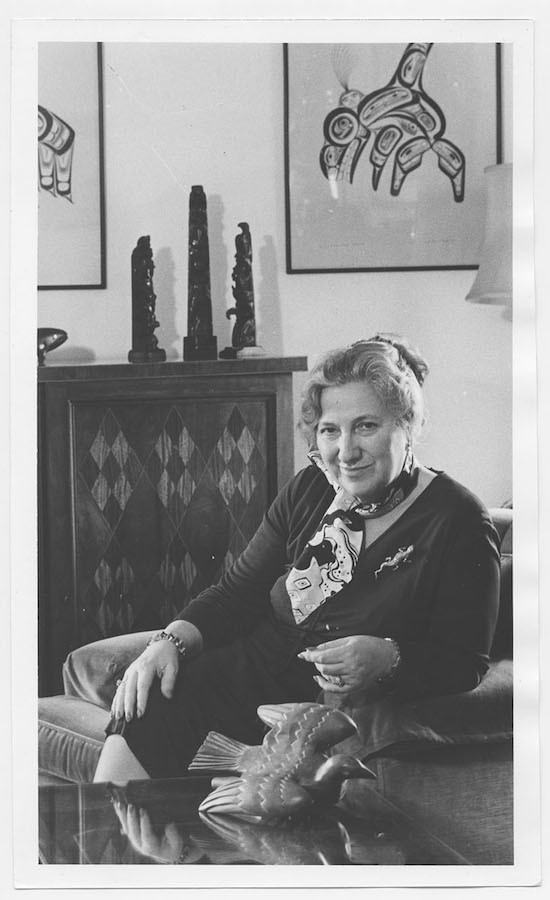
Dr. Ida Halpern
Biography
Ethnomusicologist, teacher, writer -- Ida Halpern was born Ida Ruhdofer in Vienna on July 17, 1910. She was the only child of Heinrich (Hersch Meilech) Ruhdorfer and Sabine Weinstock. Halpern was raised by her mother and grandmother in Vienna. She began her musical education at the age of 6 and graduated from the Musicological Institute of the University of Vienna. At the Institute Halpern received an education that left her well-equipped for the Canadian west coast cultural encounters she experienced over a decade later. Halpern’s educational background ensured her interest contemporary music, musical exploration, and the identity of peoples through local musical tradition. The music of folk, and its community values of culture and identity, remained a touchstone of her musical understanding. In this vein, Halpern is best remembered for her work to record First Nations’ music from across the West Coast.
When Ida arrived in settler society on the Northwest Coast, she was at the cusp of a popular appreciation for art and culture of local First Nations’ communities. During that time many of the elders were willing to record songs, naming ceremonies and other musical creations because they were concerned about losing the common usage of their Indigenous cultures. Because of the timing of her arrival, Halpern captured an unprecedented volume of sound recordings of valuable cultural creations from leading elders in Kwakwa̱ka̱̕wakw, Nuu-chah-nulth, Tlingit, Haida, and Coast Salish communities.
Ida’s first set of indigenous recordings occurred in 1947 when Billy Assu, the leader of the Kwakwa̱ka̱̕wakw communities near Cape Mudge, Quadra Island, invited Ida to his home to stage recording sessions. Promising her a hundred songs, Halpern was Assu’s guest for ten days. By the end of the visit Ida had recorded 88 songs on her Meissner recorder/player. She was convinced Assu would have reached 100 but she could not stay longer. Halpern’s next significant recording sessions occurred in 1951 when she recorded Mungo Martin in Vancouver performing traditional songs of the Kwakwa̱ka̱̕wakw people. Martin was in Vancouver with his wife Abayah to participate in the University of British Columbia’s (UBC) totem pole restoration project. During his two-year participation in the UBC project, Martin and his wife were frequent guests in the Halpern home where Ida recorded 124 of his performances. Following Martin’s recordings, Ida recorded her first Nuu-chah-nulth recordings in 1951. She made these recordings on a trip to Port Alberni with Harry Hawthorne, professor of anthropology at UBC, Charles Borden, from the same UBC department, and Wilson Duff, a graduate student who would soon direct the anthropology section of the Royal BC Museum. Her work at this time was prolific: between 1947 and 1952 she collected original musical performances from 6 hereditary chiefs; all were between the ages of 70 and 80.
Beginning in 1949, Ida began to bring her work to a public audience. In that year she brought her recordings to European audiences through a series of broadcasts on various radio stations. Several of her recordings were included in the 1953 Volume VIII of the World Library of Folk and Primitive Music, edited by Alan Lomax and Marius Barbeau, on Columbia Records. In 1957 Ida arranged, supervised and supplied First Nations’ music for Lister Sinclair’s play “World of the Wonderful Dark,” performed at the first Vancouver International Festival. In 1961 she attended the International Folk Music Council conference at Université Laval in Québec. At this conference she delivered her first major ethno-music publication, “Music of the Kwakiutl Indians.” In 1965 Ida introduced UBC’s first course in ethnomusicology.
Constantly studying and collating her musical collection, one year later Ida provided four LPs of her recordings of First Nations’ songs: Indian Music of the Pacific Northwest Coast. The albums were put out by Folkways Records through support of the Smithsonian Center for Folklife and Cultural Heritage. The albums contained extensive liner notes which were more studies in ethnography than simple musical publications. The 1967 publication was a two-disc song collection with an extensive explanatory booklet discussing the style characteristics of the music including rhythm, translation, and scales. In 1974 Ida arranged for her first publication devoted to the musical culture of a single First Nation: “Nootka: Indian Music of the Pacific Northwest”. Again the project was completed through Folkways records. On this occasion Marjorie Koers assisted Ida in the introduction. Once again a very detailed commentary on the complexities of the music of the “Nootka” accompanied the publication. Ida went on to publish a few more albums featuring Kwakwa̱ka̱̕wakw and Haida songs. In her accompanying notes the Haida collection, she offered the fundamental principles with which she has always approached her study of First Nations’ music on the Northwest Coast: “begin with an open mind and the highest respect for this unique, complex musical culture; preserve the oldest examples of authentic, hereditary songs; find the best way of understanding this important music.”
Ida Halpern died in Vancouver on February 7th, 1987. At the time of her death she was working with a filmmaker on a documentary of her life. The work was never finished. The documentary indicates Ida remained pre-occupied with her musical studies of First Nations cultures until the end.
- edited from the BC Archives website
(editor’s note: It is unclear what type of consent and copyright was collected from the singer’s when these recordings were taken. Folkways has a reputation for peddling cultural songs from a wide range of Indigenous communities. Given that she was recording in the 40s and 50s, it is quite possible that the singers did not foresee how popular recorded music would become and how wide of an audience Ida would be sharing her recordings with.)